Madeira car hire: the excess, the deposit, and what gets added at the counter
Updated October 1, 2026 · 11 min read
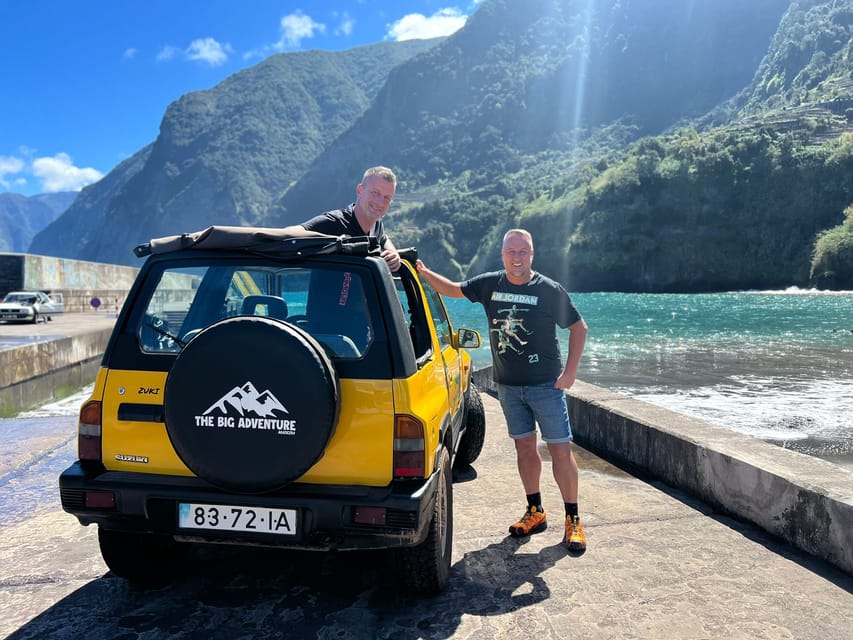
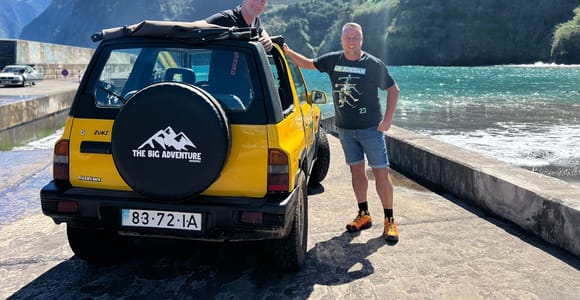
The short answer: two numbers decide what a week on Madeira costs you, and neither is the daily rate. The excess is the damage you carry yourself before the cover starts – and the standard cover excludes tyres, glass and the underside of the car, which are exactly the three things this island damages. The deposit is what gets blocked on your credit card: one Madeira company states €1,000 to €2,100 depending on the vehicle. Bring a credit card in the main driver’s name. And if those numbers make the whole idea look like more trouble than it is worth, the mountain roads are available with somebody else driving: the full-day guided jeep tour with hotel pickup, €70 for 8 hours, 4.9 stars from 2,802 reviews.
See prices and dates for the full-day guided jeep tour
The quoted daily rate for a small car on Madeira is not what the week costs you. That is not a scam, and it is not unique to this island – it is how car hire is priced everywhere. But the two numbers above decide whether you come home mildly annoyed or several hundred euros lighter, and neither of them is on the booking page you looked at.
They are not the same thing, and the counter staff will not necessarily explain the difference.
Excess and deposit: two different numbers
The excess is the amount of damage you carry yourself. Almost every rental on Madeira includes CDW – collision damage waiver – and CDW is not the same as being insured. It means the company waives its claim against you above a threshold. Below that threshold, the bill is yours. Scrape a wheel arch against a stone wall and cause €400 of damage with an excess of €1,200, and you pay all €400.
The deposit is the money the company blocks on your credit card while you have the car. It is a pre-authorisation, not a charge: the amount is reserved, your available credit drops by that much, and it is released after you return the car. “Released” is the operative word – the release is not instant, and with some banks it takes days.
Rodavante, which rents on Madeira, Porto Santo and in Lisbon, publishes the figure openly: “A pre-authorized security deposit between €1,000.00 and €2,100.00 is required depending on the vehicle group.” That is the order of magnitude to plan for. If your card limit is €1,500 and the reserved amount is €2,100, your holiday begins with a conversation at the desk.
Two practical consequences. Bring a credit card in the main driver’s name – debit cards are frequently refused for the pre-authorisation, whatever the booking page implied. And do not plan to pay for the rest of the trip on the same card, because part of its limit is sitting in that block.
What the standard cover leaves out – and why it matters here
This is the section worth reading twice, because the exclusions are not random. They describe Madeira.
Rodavante’s own terms spell out what CDW does not carry: tyres and glass (unless you take their tyre-and-glass extension), lost or damaged keys and remote controls, and damage to the undercarriage – “subframe, engine, exhaust, suspension, steering” – caused by road irregularities. Hidden damage to engine, clutch, gearbox and suspension can be charged after the car has been cleaned and inspected. And driving off paved roads, on dirt or unclassified tracks, is excluded from the cover altogether.
Now match that list against the island you are about to drive on:
- Glass. The north-coast roads run beneath cliffs. Small stone falls are ordinary there, and a chipped windscreen is one of the commonest bills.
- Tyres and wheels. Lanes in the villages are one car wide with a kerb or a stone wall on each side. Kerbed alloys are the second commonest bill.
- Undercarriage. Steep ramps into hotel garages, aggressive speed bumps, and the lip where a side road meets a main one at an angle. You hear it before you understand what happened.
- Clutch. Repeated hill starts wear a clutch – on this island the electronic signs on the ER110 report gradients of up to 22 %, so a fortnight of manual driving here is not a gentle fortnight. The contract does not say that gradients cause clutch damage; it says hidden damage to the clutch can be charged to you. Those are two separate facts, and together they are the real argument for an automatic.
- Unpaved roads. Some levada car parks and forestry tracks are gravel. Rodavante’s contract excludes damage sustained off paved roads – whether yours does the same is a question for your own terms, not an assumption. Your satnav does not know that the surface can change the insurance position.
So the honest framing is this: the standard cover on Madeira excludes several of the things most likely to happen on Madeira.
The counter upsell, and the alternative
At the desk you will be offered a top-up – super CDW, zero excess, premium protection, the name varies – that reduces or removes the excess for a daily fee. It tends to be offered with some enthusiasm.
It is not automatically a bad deal. But it has a competitor: standalone excess insurance bought from an insurer before you travel, which typically costs less per day. The difference between the two is not really the price, it is who pays first. With the counter product, the company simply does not charge you. With a standalone policy, the company charges your card and you claim the money back afterwards with the paperwork.
Before you decide, ask one question at the desk and get the answer in writing on the contract:
Does this cover include tyres, glass, the undercarriage and the roof?
If the answer is no, the product does not cover Madeira’s characteristic damage, and you are paying to be protected against the damage you were least likely to suffer. Prices for both routes move constantly and vary by company, so no article should quote you a figure – compare them on the day you book.
The other line items
Fuel. Both of the Madeira companies named here run full-to-full: you get a full tank, you bring back a full tank. Rodavante charges missing fuel plus a refuelling fee of “minimum €20.00”. Funchal Drive states the vehicle “is provided with a full tank of fuel and must be returned with the same amount”. Fill up before you reach the airport, not at the airport, and keep the receipt.
Additional driver. Rodavante lists “€20.00 / driver”. Whether that is per rental or per day is the sort of thing to confirm at the desk. If two of you are going to share the driving on mountain roads – and on a long day you should – put both names on the contract. An unlisted driver at the wheel voids the cover, which is a much more expensive mistake than the fee.
Minimum age, and why there is no single answer. This varies by company more than anything else on this page. Rodavante requires drivers to be at least 23 and no older than 75, with a licence “held for more than 1 year”. Funchal Drive sets its minimum at 19, applies a young-driver surcharge to drivers under 23, and requires the licence to have been issued at least a year before the rental starts. Same island, same week, four years apart in the age limit. Never take an age figure from a guide – including this one – as applying to the company you are booking. Read the terms of the company whose name is on your voucher.
Licence and paperwork. Bring the physical licence, not a photo of it, plus your passport or ID and the credit card in the same name. Licences from outside the EU may need an international permit alongside – another item to confirm with your company rather than assume.
Automatic or manual
Automatics cost more per day on Madeira, and they are worth considering rather than dismissing. The case for one is not laziness:
- Hill starts on gradients up to 22 %, sometimes with a car close behind you.
- Narrow lanes where you want both hands and all your attention on the walls, not on finding first.
- Stop-start on Funchal’s slopes in traffic.
The case against is the price and, if you drive a manual daily at home, familiarity. Whichever you pick, book it explicitly. “Or similar” clauses have handed people an automatic they did not want and, more awkwardly, a manual they could not drive.
The five-minute routine that saves the argument
Do this at pick-up, every time, in this order:
- Photograph the car all the way round before you leave the bay – all four sides, both bumpers, the roof, each wheel and the windscreen. Timestamps are your friend.
- Crouch and photograph the front spoiler and sills. That is where the undercarriage damage starts and where nobody looks.
- Check the fuel gauge against what the contract says and photograph the dashboard.
- Have every existing mark written onto the damage sheet, not just pointed at. “They said it was already there” is not a defence.
- Keep the pre-authorisation slip. If the block has not cleared a fortnight after you got home, that piece of paper is how you chase it.
Repeat one and three at drop-off. The whole thing takes five minutes and it is the difference between a discussion and a dispute.
Where the comparison actually happens
The version of this that costs the least is the one where you decide before you land, with the terms open in a tab, rather than at a desk at 11 in the evening with a queue behind you. You can compare hire cars for Madeira here – and the more useful question than “which is cheapest” is “which excess and which deposit”, because those are the numbers that actually vary.
If the sums have put you off the car
That is a legitimate conclusion, and we wrote out the case for and against in do you need a hire car on Madeira at all. The island’s 361 guided offers with roughly 134,000 reviews exist precisely because the answer is often no. If you want the mountain roads without being the one responsible for the clutch, four days out instead of a contract:
| Tour | Duration | From | Rating | Suits |
|---|---|---|---|---|
| Full-day jeep tour with guide and hotel pickup | 8 hours | €70 | 4.9 (2,802) | Most people: the jeep day that stops to swim in the Porto Moniz pools |
| Skywalk, Porto Moniz, Seixal and Fanal by 4WD | 8 hours | €69 | 4.9 (9,707) | Anyone who also wants the Fanal forest and the Paúl da Serra plateau |
| West Madeira waterfalls and the Fanal forest | 8 hours | €34.45 | 4.7 (4,060) | Couples and families watching the budget |
| Cabo Girão jeep adventure with wine tasting | 4 hours | €49 | 4.8 (450) | Anyone who wants half a day and a glass of wine without driving afterwards |
Check availability for the Skywalk, Porto Moniz, Seixal and Fanal 4WD day
More of the same: jeep and 4x4 tours – 73 trips from €32.63, on exactly the surfaces your rental contract excludes.
Our Recommendation
For most people: rent, but do two things before you land. Buy standalone excess insurance from an insurer rather than at the desk, and check your credit card limit against a block of up to €2,100. Compare hire cars for Madeira here and compare the excess and the deposit, not only the daily rate.
If this page has put you off the whole thing: the full-day guided jeep tour with hotel pickup, €70 for 8 hours, 4.9 stars from 2,802 reviews. One day, one price, no pre-authorisation, and somebody else answering for the undercarriage.
See prices and dates for the full-day guided jeep tour
On a budget, or for families: the west-coast waterfalls and Fanal forest tour, €34.45 for 8 hours. Half the price of the jeep days for much of the same coast, and the natural pools at Porto Moniz are on it.
Check availability for the west-coast waterfalls and Fanal forest tour
If a whole day in a jeep is not your idea of a holiday: the Cabo Girão half-day with the wine tasting, €49 for 4 hours. It is the one option here where a glass of wine does not end the day’s driving plans.
It is not the right answer if you are staying two weeks, travelling with small children, or want to chase the weather from coast to coast at short notice. In those cases the car wins even with the excess, the deposit and the exclusions – and the five-minute photo routine above is what keeps it from costing more than the rate.
The sentence to remember at the desk
You are not buying a car for a week. You are buying a defined exposure to risk, and the two numbers that define it are the excess and the deposit. Everything else on the invoice is detail.