From Pico do Areeiro to Pico Ruivo: the island's toughest day of walking
Updated September 9, 2026 · 6 min read
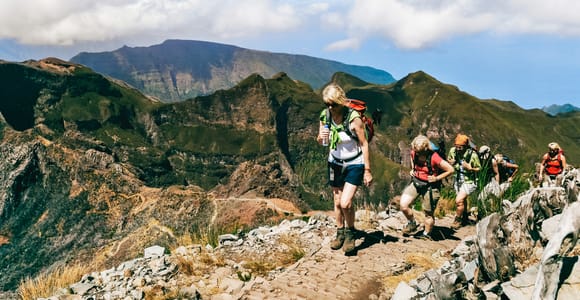
The start sits at 1,818 metres, the finish at 1,862 metres. Anyone who looks only at those two figures takes the walk from Pico do Areeiro to Pico Ruivo for a stroll along a ridge. That is the miscalculation that catches many people out every year. With around 2,808 reviews, the guided walk is the most booked in our range – and the only one where we spell out who is better off skipping it.
A 44-metre difference, 700 metres of climbing
The ridge is not a single crest but a series of notches. The path repeatedly drops to around 1,490 metres and climbs back up again, several times over. Various sources put the total climb at around 700 metres of ascent – and a similar amount of descent, which often works the knees harder than the climbing does.
The real measure of this walk, though, isn’t the altitude gain but the steps. Large stretches of the route are staircases cut into the rock, plus metal steps – thousands of them, and they come in runs: thirty down, eighty up, then straight back down again. By the third hour it’s no longer about strength but about the legs losing their rhythm. The tourism authority states around three hours for the official 6.1-kilometre route; the guided tours in our range are listed at 8 hours, including transfer and breaks. Both figures are honest, they simply measure different things.
Exposure: not a question of fitness
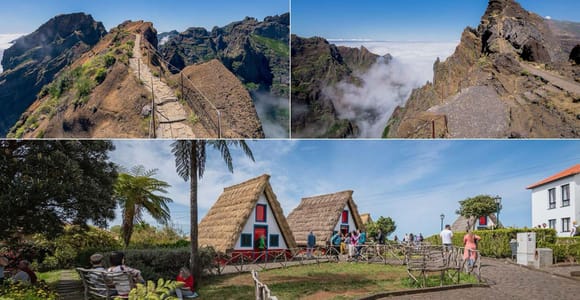
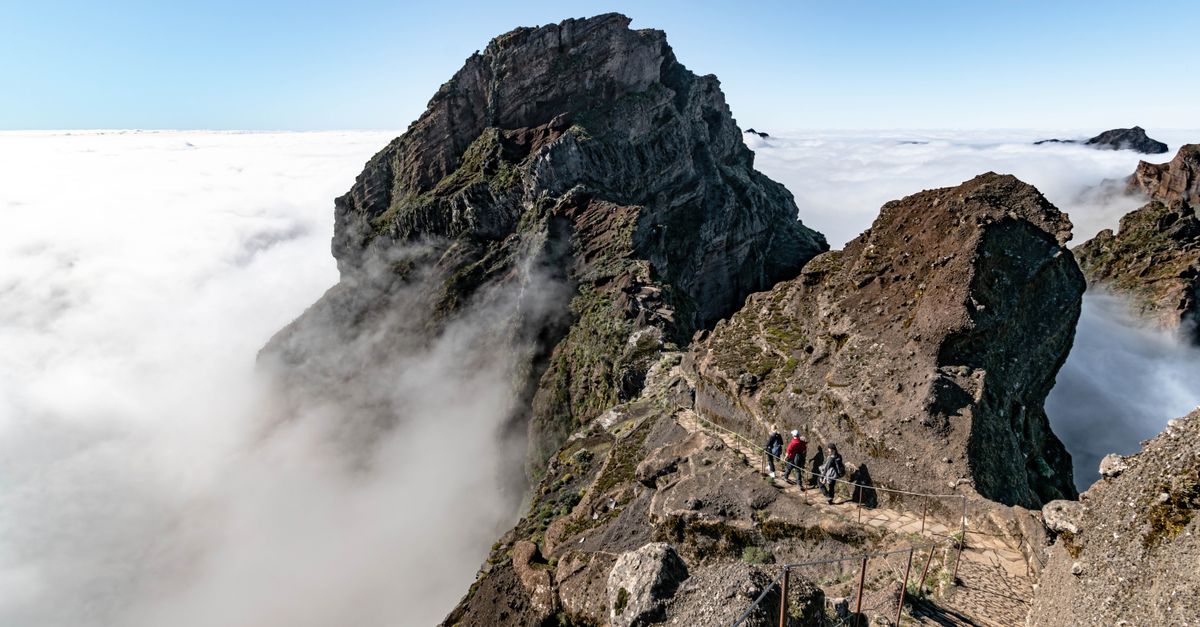
Good fitness doesn’t help here. Several sections are narrow ledges cut into a sheer wall, with the terrain dropping away steeply alongside. These spots are usually secured with railings and slope netting – usually, not guaranteed; their condition and extent change after every storm.
For someone who doesn’t mind heights, that’s impressive. For someone with a fear of heights, it’s a day where you get stuck halfway: from the Pedra Rija viewpoint onward, the route is one-way, and turning back means doing it all again in reverse. If you don’t know for certain how you react to exposure, this is not the place to find out.
Five tunnels, and a head torch is part of the kit
Five tunnels driven through the rock belong to the route, left raw and unlit. The longest measures around 150 metres – long enough that there’s genuinely nothing to see in the middle, and the floor is wet and uneven.
A head torch is therefore not an extra but a requirement. A phone doesn’t serve well here: you need both hands in the tunnels and on the steps leading to them, and anyone holding a light in their fist ends up shining it wherever they happen not to be looking.
Two route options – and you don’t decide
The route offers two options: the direct western variant through the tunnels and up the steep staircase that bypasses Pico das Torres (1,851 m), and a longer eastern detour around its flank – around one and a half kilometres and considerably more effort.
Which of these is passable on a given day is not up to the hiker. Individual sections get closed after rockfall or heavy rain and reopened later; what a trip report from last year says can be out of date today. Some designated trails also require a time-slot ticket bought in advance. On a guided tour, the operator takes care of that – the current status is always stated on the respective booking page.
Why going guided is worth more here than elsewhere
First, this is a point-to-point route, not a loop. Anyone driving a rental car to Pico do Areeiro ends up at Achada do Teixeira – by road, a long way around the massif back to their own car, with no scheduled bus in between. That leaves a taxi or walking back. A tour solves this with the transfer; that’s the real value here.
Second, the weather call in the morning. Funchal and the mountains have different weather. Along the seafront the sun can be shining while the peaks sit in cloud and wind stands over the ridge. A guide sees this early and decides which route is actually feasible – or whether to rework the day. Why the island behaves this way is explained in our piece on weather in Funchal versus the mountains.
Cold, even when it’s summer down below
At 1,800 metres it’s a different season from the harbour. Add to that the wind, which is barely broken anywhere along the ridge. Several layers, a windproof jacket, hat and gloves make sense even in July – as do sturdy, treaded shoes, because the steps get slippery when wet. Above the cloud layer, the sun’s radiation is strong even when it feels cool.
Who this day is not for
Without beating around the bush: anyone who suffers from a fear of heights does not belong on this ridge – that’s not a question of courage or training. Anyone with knee problems will find the descending steps the opposite of a holiday moment. Small children have no place here; we deliberately don’t state a binding minimum age – operators set different limits, and what applies is on the respective booking page. And anyone looking for a relaxed walk with a view has picked the wrong tour.
How your body reacts to altitude, cold and hours full of steps is something only you can judge – and if in doubt, that’s your doctor’s call, not a travel blog’s.
The honest alternative
If it’s the view you’re after and not the trail: drive to the viewpoint at Pico do Areeiro and walk the first few minutes on the paved path. The sea of clouds, the basalt spires, the vastness – you’ll see all of it there, without tunnels and without steps. No hiking tour is needed for that; more on this in Pico do Areeiro with kids.
And for anyone who wants to hike, but not like this: 25 Fontes and Rabaçal is the prettier water day, and our overview of the best levada walk for beginners ranks the easy routes by effort.
More to explore
Levada walks – 153 offers from €16.50, median €58.50, 56,268 reviews. This is where you’ll find the walk from Pico Areeiro to Pico Ruivo for €48 (4.5 stars, 8 hours).
Canyoning and adventure – 66 offers from €19, median €65.30. Athletic, but not on a ridge.
Private tours – 20 offers from €40, median €197.50. Your own pace, no arguments if you want to stop.
For anyone who’d rather take in the summit as a stop on a round trip: the eastern tour via Pico Arieiro, Santana and the laurel forest costs €36.48 for 7 hours – with no steps at all.