One drive, one day: Funchal to Porto Moniz and back over the plateau
Updated September 19, 2026 · 8 min read
If you only drive one day on Madeira, drive this one. It is a loop: down the motorway along the south coast, over the mountains to the north, west along the cliff road to the far corner of the island, and back across the high plateau in the middle.
Funchal to Porto Moniz is only about an hour and a quarter if you go straight there. Nobody goes straight there, and that is the point – the day is long because of the stops and the mountain sections, not because of the distance. Reckon on leaving at eight and being back for dinner.
The shape of it
Funchal → Câmara de Lobos → Cabo Girão → Ribeira Brava → Encumeada → São Vicente → Seixal → Porto Moniz → Paul da Serra → Ribeira Brava → Funchal.
The first half runs on the VR1, the expressway along the south coast. It is tunnel after tunnel, it is fast, and it flatters the island: you cover in twenty minutes what took an hour before it was built. The second half is the opposite – the ER228 over the Encumeada pass, then the coast road on the north side, then the ER110 across the plateau. That is where the day actually happens.
Câmara de Lobos, twenty minutes out
A working fishing harbour with the boats pulled up on the shingle, close enough to Funchal that it is barely a drive. Stop for a coffee, look at the boats, and understand something about the rest of the day: this is where poncha comes from, and the bars pour it generously.
Which brings up the rule that shapes everything else. Portugal’s blood-alcohol limit is 0.5 g/l, dropping to 0.2 g/l for holders of a probationary licence and for professional drivers. Article 81 of the Código da Estrada sets both figures; at 1.2 g/l and above it stops being an administrative matter and becomes a criminal offence carrying up to a year’s imprisonment. If poncha is on your list for today, the person driving does not have one. If everybody wants one, today is a tour day, not a driving day.
Cabo Girão, forty minutes out
A glass-floored platform cantilevered out over one of the highest sea cliffs in Europe, with the terraced smallholdings – the fajãs – visible directly below your feet. It is a five-minute experience and a memorable one.
The platform sits around 580 metres above the water. Practicalities: it opens early, around eight in the morning, and the closing time shifts with the season – later in summer than in winter. There is an entrance fee, charged at a turnstile, and the amount has changed often enough that sources contradict each other; children under 12 and Madeira residents go free. Parking is free, and it fills with coaches from mid-morning, which is the first argument for the early start.
Over the top: Encumeada
At Ribeira Brava you leave the coast and turn inland onto the ER228 for the Encumeada pass. This is the crossing between the two halves of the island, and it is the first place the drive gets serious: sustained climbing, tight bends, and a view down two valleys at once when it is clear.
When it is not clear, you drive into cloud somewhere on the way up and come out of it on the other side. That is normal and not a reason to turn round. Slow down, keep the lights on, and remember that the fog on Madeira is usually a layer rather than a blanket – there is often blue sky a few hundred metres higher or lower.
The north coast: São Vicente, Seixal, Porto Moniz
The north side is a different island. Wetter, greener, steeper, and far less built up. The coast road strings together three places worth the stop:
São Vicente sits where its valley meets the sea, with a village centre that repays twenty minutes on foot.
Seixal is the one people photograph: black volcanic sand, a natural pool cut into the rock, and a waterfall coming off the cliff onto the road nearby. Parking is limited and the good spots go early.
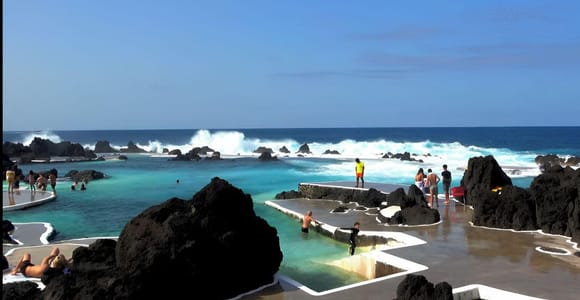
Porto Moniz, the far north-west corner, is where the loop turns. The natural pools here are the island’s set piece – lava rock basins that the Atlantic refills by itself, with changing rooms, a bar, a children’s pool, a lifeguard and a car park on site. Entry is charged. The hours are shorter in winter than in summer, and whether you actually swim depends on the sea that day: when the swell is up, the pools are not the sheltered bath the photographs promise. Ask at the entrance before you change.
Lunch here, if you want the timing to work. You are roughly at the halfway point in effort, even though you are much further along in distance.
The way back: ER110 across Paul da Serra
This is the stretch people remember, and the one to think about before you commit to it.
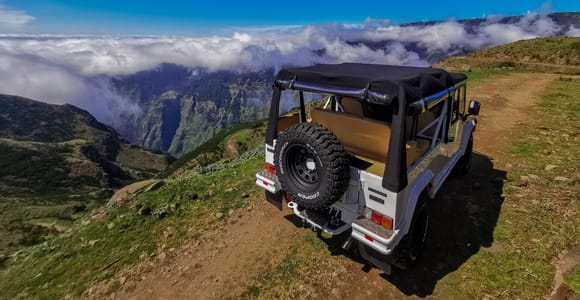
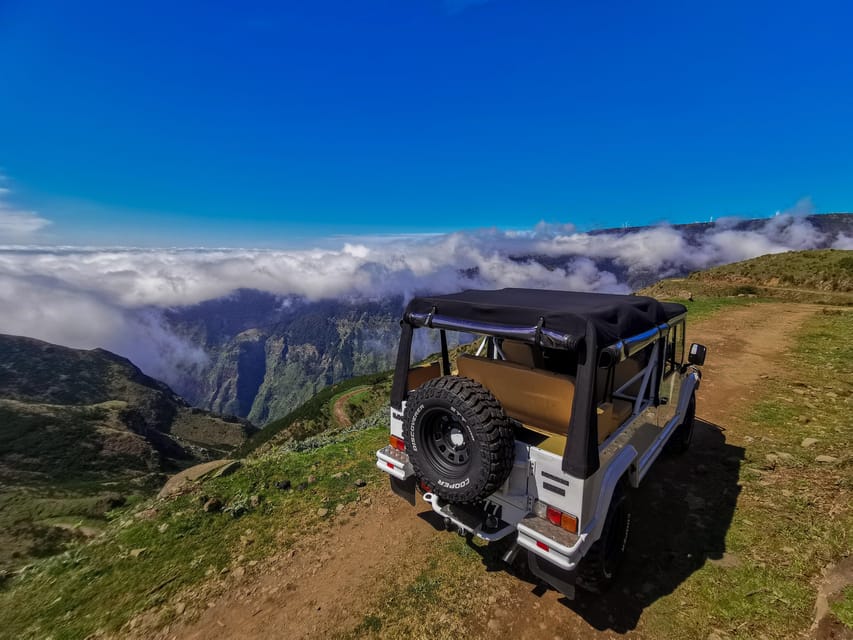
The ER110 runs across Paul da Serra, a plateau at around 1,400 metres that looks nothing like the rest of Madeira – open, almost treeless, more Scottish moor than Atlantic island, with wind turbines turning on the ridge. On a clear afternoon you drive above the cloud with the whole interior below you.
On an unclear afternoon you drive inside the cloud, visibility drops to a few metres, and the road’s electronic gradient signs go up to 22 %. It is not dangerous if you treat it seriously – slow right down, low gear, lights on, no overtaking – but it is no longer scenic, and there is no shame in the alternative: back the way you came along the coast and onto the VR1 at Ribeira Brava. That costs you perhaps forty minutes and gains you a road you can see.
One more reason to take the plateau when it is clear – and only then, the fog rule above still wins: the ER105 turning for Rabaçal comes off the plateau road, and the car park there is free. That is the starting point for the 25 Fontes and Risco walks, and if you have a booking for a late slot you can chain it onto the end of this drive. Ours is a separate day in its own right, though, and doing both properly in one day is optimistic.
What changes between summer and winter
Summer is about crowds and timing. The car parks at Cabo Girão, Seixal and Rabaçal fill before eleven. Leaving Funchal at eight is not enthusiasm, it is the whole strategy. The plateau is more often clear, the north coast is warm enough to swim, and the daylight lets you take the long way home.
Winter is about weather and daylight. The plateau is genuinely cold and frequently fogged in; the north coast takes the Atlantic swell, so the sea pools are more often a look than a swim; and the light goes early enough that the ER110 in the dark becomes a real consideration. The compensation is that you may have Seixal to yourself. In winter, plan the loop clockwise as described but decide at Porto Moniz whether the plateau is on – and check the sky before you turn inland, not after.
Either way: do not plan a fixed itinerary, plan two versions of the day. The island runs several weather systems at once, which is a subject of its own, and the ability to change your mind at eleven in the morning is most of the value of having the car.
Parking, briefly
Out on the route, parking is free and the problem is availability, not cost. Back in Funchal it is the other way round. The municipal meter zones are priced by how long you can stay: the yellow zone nearest the centre is €1.83 an hour with a maximum of 56 minutes; green is €1.38 with 100 minutes; red is €0.76 with 197 minutes; brown is €0.54 with 400 minutes. If you are returning tired at seven in the evening, the brown or red zone plus a ten-minute walk is a better end to the day than circling the old town.
When the guided version is the better day
Three honest cases, and one of them applies to a lot of people:
- If anything on the day involves drinking. Poncha at Câmara de Lobos, wine with lunch, a tasting on the way back – any of these and the drive stops being available. A tour is not the compromise here, it is the only way to have that day.
- If the plateau makes you uneasy. Twenty-two per cent gradients in fog are a legitimate thing to want to experience from a passenger seat. The jeep and 4x4 tours – 73 trips from €32.63 – run this ground daily with drivers who do it for a living, and they will reverse the route in the morning if the cloud is sitting in the wrong place.
- If you are on the island for two or three days. The overhead of collecting a car, parking it, and returning it eats a disproportionate share of a short trip. Among Madeira’s 361 offers with roughly 134,000 reviews, the full-day trips in that same jeep and 4x4 category cover most of this loop for less than a day’s rental plus fuel plus parking.
If none of those apply and you want the wheel, that is the right call – and the comparison is worth doing before you land rather than at the desk. You can compare hire cars for Madeira here. What the daily rate leaves out is covered separately in our piece on excess, deposit and the counter, and the underlying question – whether you need a car at all – in this one.
The short version
Leave at eight. Coffee at Câmara de Lobos, skywalk at Cabo Girão before the coaches, over Encumeada, lunch at Porto Moniz. Then look up: clear plateau, go home over the ER110. Cloud on the plateau, go home along the coast.
That single decision, made at lunchtime, is the difference between the best drive on Madeira and an hour of staring at fog through a windscreen.