Funchal: what's worth it in the city – and what isn't
Updated September 2, 2026 · 7 min read
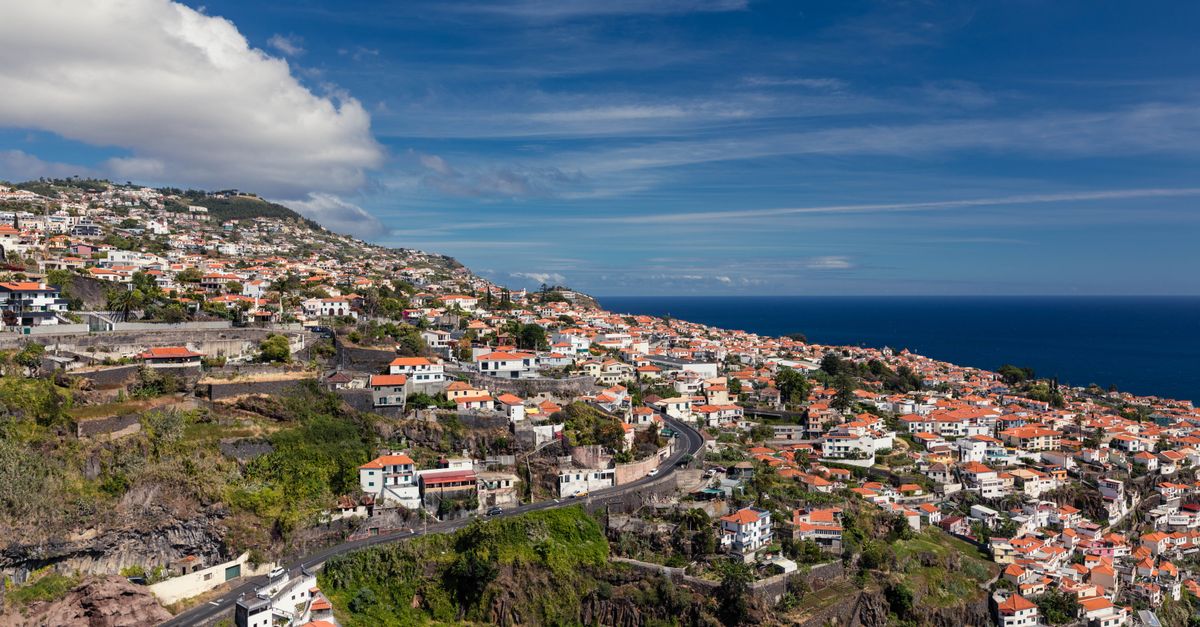
Funchal isn’t a city you stroll through – it’s one you walk up and down. It sits in a natural amphitheatre open to the sea: the harbour at the bottom, and – still within the city limits – residential districts several hundred metres up the hillside. Miss that on the map, and you’ll plan the first day wrong.
One more thing belongs at the start, because it shapes half of the trip planning: on Madeira, the coast and the mountains have different weather. The sun can be out on the promenade while the peaks sit inside a cloud. A grey day in the mountains is therefore a good day for the city – and a bright morning over the mountains is too good to waste on the market. The reasons are explained in the article on Funchal weather versus the mountains. Madeira is a mountain destination, not a beach one; Funchal is the base for that – and worth two to three good days in its own right.
Slope first, list second
A rule of thumb the map doesn’t show: running parallel to the sea is flat, moving away from the sea goes uphill. From the marina to the Zona Velha is a level walk of a good quarter of an hour; two streets inland, the same distance can be a flight of steps with thirty metres of climb. Anyone who links the flat sights – the market, the old town, the cathedral, the marina, the promenade – on foot and takes the cable car up to Monte has a pleasant day; mixing the two leaves you tired by the afternoon. Sturdy shoes with grip aren’t an overstatement here: many pavements are polished basalt cobbles, and they turn slippery when wet.
Mercado dos Lavradores
The market hall dates from 1940, designed by Edmundo Tavares, and would be worth a look even if nothing were sold inside: an open courtyard, galleries running round it, large azulejo panels on the façade and at the entrance. A few steps down is the fish hall, where the black scabbardfish – espada, its face takes some getting used to – is cut up on marble slabs. That’s the part most worth seeing, and it’s liveliest in the morning.
Realistically, allow 30 to 45 minutes. Friday morning is the liveliest, because that’s when growers come in from the villages – and the busiest for the same reason. The hall stays closed on Sundays and public holidays; exact hours are on the market’s own page.
An honest warning: at the fruit stalls upstairs, there’s a recurring pattern – you’re invited to sample something, a bag gets filled, and the price only appears at the scale. Not every stall does this, but often enough that it’s become a running theme in reviews. The countermeasure: ask for the price per kilo and the total before it’s weighed. As a sight, the market is still worth it; for buying fruit, the supermarket is the calmer option.
Zona Velha and the painted doors
East of the market lies the old town. Its best-known feature is younger than most people assume: the project Arte de Portas Abertas began in 2010, and since 2011 artists have been working their way through the Rua de Santa Maria; by now there are around two hundred painted doors. There were no rules on motif or style – naive painting next to photography, door after door.
Two time windows, two different streets. Early in the morning you see the doors: closed, no tables in front of them, no people in the shot. In the evening you see the neighbourhood – restaurants set tables right into the middle of the lanes, and it gets tight and loud. Come early to photograph, come late to eat. Everything here is at sea level and flat; at the eastern end stands the 16th-century sea fortress of São Tiago.
The Sé Cathedral
Unremarkable from the outside; inside is the reason to go in at all: the wooden ceiling from the early 16th century, made of native cedar in Mudéjar knot ornamentation, partly inlaid. Built from 1493, consecrated in 1517 – Funchal was at the time the seat of a bishopric that stretched from Brazil to East Asia.
Time needed: a quarter of an hour, most of it spent looking up. The church sits centrally between the Avenida Arriaga and the market, so you pass it anyway. During Mass it isn’t a sight to visit, but a church.
The cable car to Monte
The valley station is at the eastern end of the promenade, in the Parque Almirante Reis at the edge of the old town. From there it’s a good three kilometres and around 560 metres of ascent up to Monte, taking about fifteen minutes; there’s no fixed timetable. The route over rooftops, valleys and terraced gardens is the real reason to take the ride – the view beats any bus. It gets busy in the late morning, especially when cruise ships are in port; it’s quieter early or in the afternoon.
Walking up is possible and still rarely recommended: over five hundred metres of climb on asphalt. Walking down takes a good hour and is hard on the knees. Regular buses also run up there – the cheap option without the view. We deliberately don’t quote prices, as they change; they’re listed with the operator.
Up in Monte: church and tropical garden
From the mountain station it’s a few minutes to the church of Nossa Senhora do Monte with its broad flight of steps. In a side chapel lies the last Austrian emperor, Charles I, who died in exile on Madeira in 1922 – that a Habsburg is buried here of all places surprises most visitors.
Opposite the mountain station begins the Jardim Tropical Monte Palace, which at around 70,000 square metres is the main reason to come up here at all: Japanese ponds, Madeiran laurel-forest plants, azulejo panels and a mineral and art collection side by side – more a walk-through cabinet of curiosities than a botanical trail, and precisely for that reason it also works under an overcast sky.
Two to three hours is realistic, anything less isn’t worth it. The most important planning point: the garden slopes down into the valley. You go down first and have to climb it all back up at the end, up many flights of steps – you can’t see that on the way in. A second cable car also runs from Monte to the Botanical Garden; anyone wanting both has a full day planned.
The wicker toboggans – the honest assessment
Two men in white, wearing straw hats, push a wicker basket on wooden runners down the road and steer it with ropes and the soles of their shoes. It’s been around since about 1850, back then as a means of transport for the residents of Monte. Today it’s the island’s best-known postcard image.
Looked at soberly: the run is about two kilometres long and takes roughly ten minutes. It ends in Livramento – not in the city itself, but in a residential district above it; from there you continue down by bus, taxi, or on foot in just under an hour. Payment is per toboggan, not per person, in cash on the spot; the Carreiros do Monte themselves quote the current figure. A photo sale and a souvenir stand wait at the end.
Worth it for: anyone who wants to have done it once; families, provided expectations are managed beforehand; travellers who are visiting Monte anyway and treat the descent as transport rather than as an attraction. Not worth it for: anyone expecting a thrill. It isn’t a fairground ride – the pace is moderate, and on flatter stretches the Carreiros pull the toboggan themselves. Anyone watching their budget gets considerably more time elsewhere on the island for the same amount.
Guided half-day tours combine the Nun’s Valley (Curral das Freiras), Monte and the toboggan run – the most-booked one is priced at €44 for around four hours, with 4.7 stars from over 2,000 reviews. More of these under things to do in Funchal.
Madeira wine: the wine cellars
Madeira wine is the only wine that benefits from heat. It’s matured warm – aged for years under the roof using the canteiro method – and is practically indestructible afterwards: an opened bottle keeps for months. That’s exactly why it travelled halfway round the world in the 18th century.
The best-known address is the Adegas de São Francisco on the Avenida Arriaga, right in the centre, in the island’s oldest wine cellars. Tours run in several languages and end with a tasting; allow one to two hours. Tasting covers the full range of styles, from dry Sercial to sweet Malvasia – anyone who only knows the sweet kind is in for a surprise. The city’s best rainy-day plan: indoors, central, and flat to reach.
The CR7 Museum
On the Praça do Mar near the marina is the museum dedicated to Cristiano Ronaldo, who was born in Funchal. Inside: trophies, shirts, Ballon d’Or awards; outside: the bronze statue, with someone always queuing for a photo. Honestly: half an hour, maybe three-quarters for fans. It’s a trophy collection, not an exhibition with a narrative – football fans will enjoy it, and non-fans won’t miss anything. At least it sits on the flat route between the marina and the old town.
Promenade, marina, parks and views
What often gets overlooked, because it doesn’t cost admission:
- The seafront promenade heading west. From the marina along the coast to the Lido and on towards Praia Formosa; the Lido promenade alone runs for about two kilometres. Flat, partly through tunnels – sections can be closed in heavy swell. The city’s best morning walk.
- The marina. Among the sailing boats sits the replica of the Santa Maria de Colombo; most boat trips depart from here.
- Parque de Santa Catarina. The city’s large park above the harbour, with a view over the bay.
- Fortaleza do Pico. The 17th-century fortress above the old town. The climb is short but steep – expect just under a quarter of an hour uphill. The panorama over the city, harbour and mountains is the best one reachable without a vehicle.
When the mountains are grey – and when they aren’t
The city is the plan B you should work out in advance. If the cloud sits at 800 metres, the day is lost for the peaks but ideal for the market, the cathedral, the wine cellars and Monte Palace – the garden is even better in diffuse light. A different rule applies on the water: boat trips don’t care about mountain fog, but they do care about the swell.
The current listing for Madeira comprises 387 offerings from €10 with a combined total of over 129,000 reviews. Of these, what can be done from Funchal in a few hours:
- Things to do in Funchal – 61 offerings from €10, median €50; among them the most-booked old-town walking tour at €16.40 for two hours, 4.7 stars from almost 3,900 reviews.
- Whale and dolphin watching – 28 trips from €35, departing from the marina.
- Boat trips – 71 offerings from €16.50.
- Sunrise and sunset – 35 tours from €19; the most-booked evening sailing tour is priced at €55.
- Jeep and 4x4 tours – 73 tours from €33.
- Private tours – 20 offerings from €40.
- Levada walks – 153 tours from €16.50; the forest stays pleasant even under low cloud.
And what lies outside the city
Pico do Areeiro, Cabo Girão, Porto Moniz, Fanal, Ponta de São Lourenço and the levadas don’t belong in this article, because they aren’t in the city – they’re gathered together under what to see in Madeira. We’ve described three of them individually, because they’re the ones most often planned wrong: which levada to start with, the hike to the 25 Fontes and Rabaçal, and the Fanal fog forest, which is best on precisely the greyest weather.
The verdict
Two full days are enough for Funchal, if you lay them out right: one flat day by the sea with the market, the old town, the cathedral, the wine cellars and the promenade – and one day for Monte, with the cable car and the garden. The wicker toboggans fit into the second one, if you want them. Anything beyond that is the island, not the city.