What to See in Madeira: What's Worth It – and What You Can Skip
Updated September 2, 2026 · 7 min read
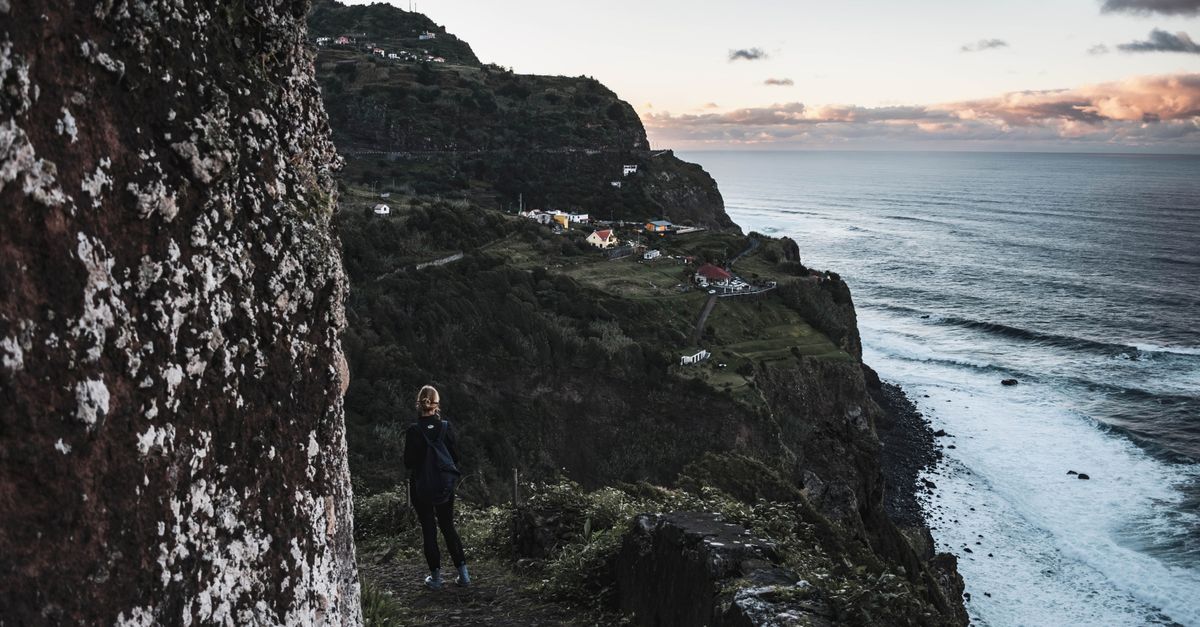
Madeira is 57 kilometres long, 22 kilometres wide, and 1,862 metres high at its peak. Those numbers explain almost everything: a mountain range packed into the area of a mid-sized county. Every drive takes longer than the map promises, a different climate waits behind every tunnel – and Madeira is a mountain destination, not a beach destination.
The Rule That Comes Before Everything Else
The sun can shine on Funchal’s promenade while Fanal sits in fog and the peaks are locked in solid cloud. That’s normal: a dry south side, a wet north side, and a ridge between them where the clouds pile up.
Two things follow. A weather app for “Madeira” is pointless, since it describes an island that doesn’t really exist – why, is explained in Funchal weather versus the mountains. And a guided tour is worth more here than elsewhere: the guide decides each morning which route will pay off.
Most tours start in Funchal. We leave the city itself out here – that’s covered in What to see in Funchal. This is about the island around it.
Pico do Areeiro: The Peak You Can Drive To
At 1,818 metres, it’s the third-highest peak and the only major one with a road to it; a few minutes from the car park to the viewpoint. From Funchal that’s about 25 road kilometres via Poiso, in practice 40 to 50 minutes: narrow, winding, nobody drives fast in morning fog.
When it’s worth it: above the clouds. If the cloud layer sits below 1,800 metres, you stand in sunlight above a white sea with only the other peaks poking through.
Honestly: just as often you’re inside the cloud, seeing thirty metres ahead. For sunrise the upper car park fills early, and it’s colder than expected – single-digit temperatures in the wind, normal even in summer. Without a car and without hunting for parking: Sunrise and sunset tours from €19.
Pico Ruivo and the PR1: The Classic Stage
At 1,862 metres, Pico Ruivo is Madeira’s highest point – reachable only on foot, no exceptions. Two routes make sense:
- From Achada do Teixeira, above Santana in the north: 2.8 kilometres each way, about ninety minutes round trip. The easiest, best-maintained route up the island’s highest mountain.
- The PR1 from Pico do Areeiro, officially a good six kilometres one way, over Pico das Torres (1,851 m), through tunnels and long flights of steps. About three hours one way – anyone returning to their car walks it all again.
Since the PR1 is one-way, you need a transfer at the far end, so it’s almost always booked rather than arranged yourself: €48 for around 8 hours, 4.5 stars from over 2,800 reviews.
One note: marked trails need a ticket bought in advance with a time slot, and sections can close after storms or fires. Prices and closures change too fast for a figure here – on a guided hike, the operator handles it.
The Levadas: The Real Reason to Come Here
Levadas are narrow water channels, cut into the hillsides over centuries to carry rain from the wet north side to the dry south side – well over 2,000 kilometres of them. A maintenance path runs alongside almost everywhere, and it’s now the island’s hiking network.
The appeal: they follow the water’s gradient and are almost level – laurel forest and ravines without the climb a comparable view costs elsewhere. The price is tunnels needing a torch, and drops on one side.
With 170 listings from €16.50, this is the largest category we cover. Which route suits beginners is covered in Best levada walk for beginners; the full overview is under Levada walks.
Rabaçal and the 25 Fontes
Rabaçal is tucked away in the west, below the Paúl da Serra plateau. Several levadas set off from there, the best known leading to 25 Fontes: a basin where dozens of trickles fall from the cliff face – Madeira’s most photographed walk, and busy to match.
One quirk of getting there: the last stretch down into the valley is closed to traffic, so you walk it or take the shuttle. Plan on a full day. More in the 25 Fontes and Rabaçal hike; as a guided day trip, Rabaçal costs €48, 4.8 stars from over 2,500 reviews.
Fanal: Only in the Fog
A highland pasture at around 1,150 metres on the north-western edge of the Paúl da Serra, dotted with centuries-old stinking laurel trees. In fog, one of Europe’s strangest places; in sunshine, a green meadow with old trees and cows – pretty, but not worth a ninety-minute drive. Why, is explained in Fanal: why fog is the better case. No bus goes there; without a rental car, a tour is the only way in.
Porto Moniz, Seixal and the North Coast
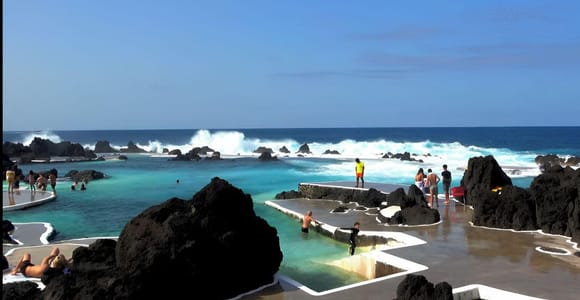
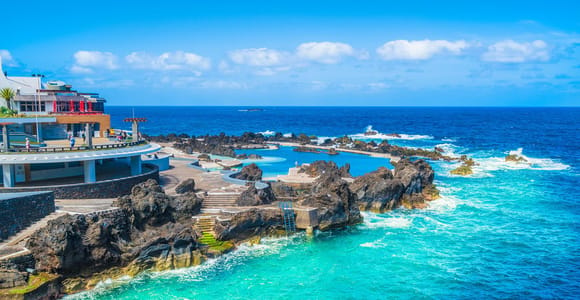
Porto Moniz sits at the far north-western tip, about 50 kilometres from Funchal, around an hour via the tunnel. Famous for its natural seawater pools, formed from solidified lava and renewed with every tide: a managed area with lifeguards and showers, plus free, rougher pools.
Honestly: the pools close when the sea is rough, and that’s no rarity here – anyone crossing the island just for them needs a plan B. The drive is still almost always worth it, because the route itself is the attraction: sheer cliffs, waterfalls beside the old road, the Véu da Noiva viewpoint between Seixal and São Vicente.
Seixal, east of Porto Moniz, has the prettier pools: black rock, a lava arch over the entrance, less crowded. The way down is steep.
This western loop – Cabo Girão, Porto Moniz, Seixal, Fanal – is the island’s most-booked land tour: €69, 8 hours, 4.9 stars from over 9,500 reviews. The 4x4 version also reaches the narrow side roads: Jeep and 4x4 tours from €33.
Cabo Girão and Câmara de Lobos
Cabo Girão, west of Funchal, drops around 580 metres almost straight into the sea, with a glass-floored platform over the edge at the top. Marketing calls it Europe’s highest cliff; that’s disputed – Norway has higher ones. Not in dispute: the view, and the time needed – fifteen minutes. Not a day’s destination, but almost always worth a stop heading west.
Câmara de Lobos, eight kilometres west of Funchal, is the fishing village Winston Churchill painted in 1950: colourful boats, a tight harbour, bars serving poncha. An hour is enough, and since it’s so close, you can get there by scheduled bus.
Curral das Freiras and the Central Mountains
“Nuns’ Valley” sits in a basin in the island’s interior, ringed by sheer walls. The classic view is from Eira do Serrado at 1,095 metres, a good half hour from Funchal. Below, there are chestnuts in every conceivable form.
One of the few major sights that works as a half-day trip: from €25.20 for 3.5 hours – good for anyone short on time, or waiting on the weather, without committing a whole day.
Ponta de São Lourenço: The Eastern Tip
In the far east, Madeira tapers into a narrow, bare peninsula that no longer looks like Madeira: no forest, barely any green, layers of red and ochre rock, the Atlantic on both sides. The PR8 runs from Baía d’Abra to Casa do Sardinha, officially around four kilometres each way, two and a half hours allowed; most take longer.
Honestly: no shade anywhere along the route, and it’s rarely still. At midday in summer it’s no pleasure; early morning or late afternoon, it’s one of the island’s finest walks. From the airport, the peninsula is just around the corner.
Santana: The Honest Case
The triangular thatched cottages of Santana on the north coast are in every Madeira brochure. What isn’t: nobody lives in them any more. The row next to the town hall is preserved heritage, partly souvenir shops; the visit takes twenty minutes.
No reason to skip it – but not a reason to travel there specifically either. Santana makes sense as a stop on a north-east loop, with Pico do Areeiro or the laurel forests near Ribeiro Frio. That’s how it’s sold: an eastern loop with Pico do Areeiro, Santana and Laurissilva costs €36.48 for 7 hours, 4.8 stars from over 3,100 reviews.
And the Sea?
Not the main event, but not nothing. Dolphins live off Madeira year-round, and whale species pass through – the chance is high, never guaranteed. The island’s most-booked excursion overall is a catamaran trip for whale and dolphin watching at €35: Whale and dolphin watching from €35, Boat trips from €16.50. More active: the gorges of the central mountains, Canyoning and adventure from €19.
Car, Bus or Tour?
Plainly: a rental car gives you flexibility, and lets you wait until the fog settles where it should. In exchange you drive narrow mountain roads with gradients unlike central Europe – and each morning you won’t know where today’s cloud will sit.
Scheduled buses reach the larger coastal towns – Câmara de Lobos, Machico, Santana, and with patience Porto Moniz. They practically don’t go into the mountains: without your own vehicle, Fanal, Rabaçal and Achada do Teixeira are only reachable on a tour.
Our current Madeira listings run to 387 offers from €10, median €60, with around 129,651 reviews between them. Anyone travelling as a group, or who wants to set their own programme, will find the option under Private tours from €40 – the one where you’re allowed to just stop because the light happens to be right.
Keep exploring: Levada walks from €16.50 · Jeep and 4x4 tours from €33 · Whale and dolphin watching from €35 · Sunrise and sunset tours from €19 · Private tours from €40